
Heat Treatment Fixtures: Trends Reshaping Fixture Sourcing Decisions
How thermal-cycle demands, alloy selection, and drawing-based custom casting are changing the way buyers specify heat-resistant charge trays and racks.
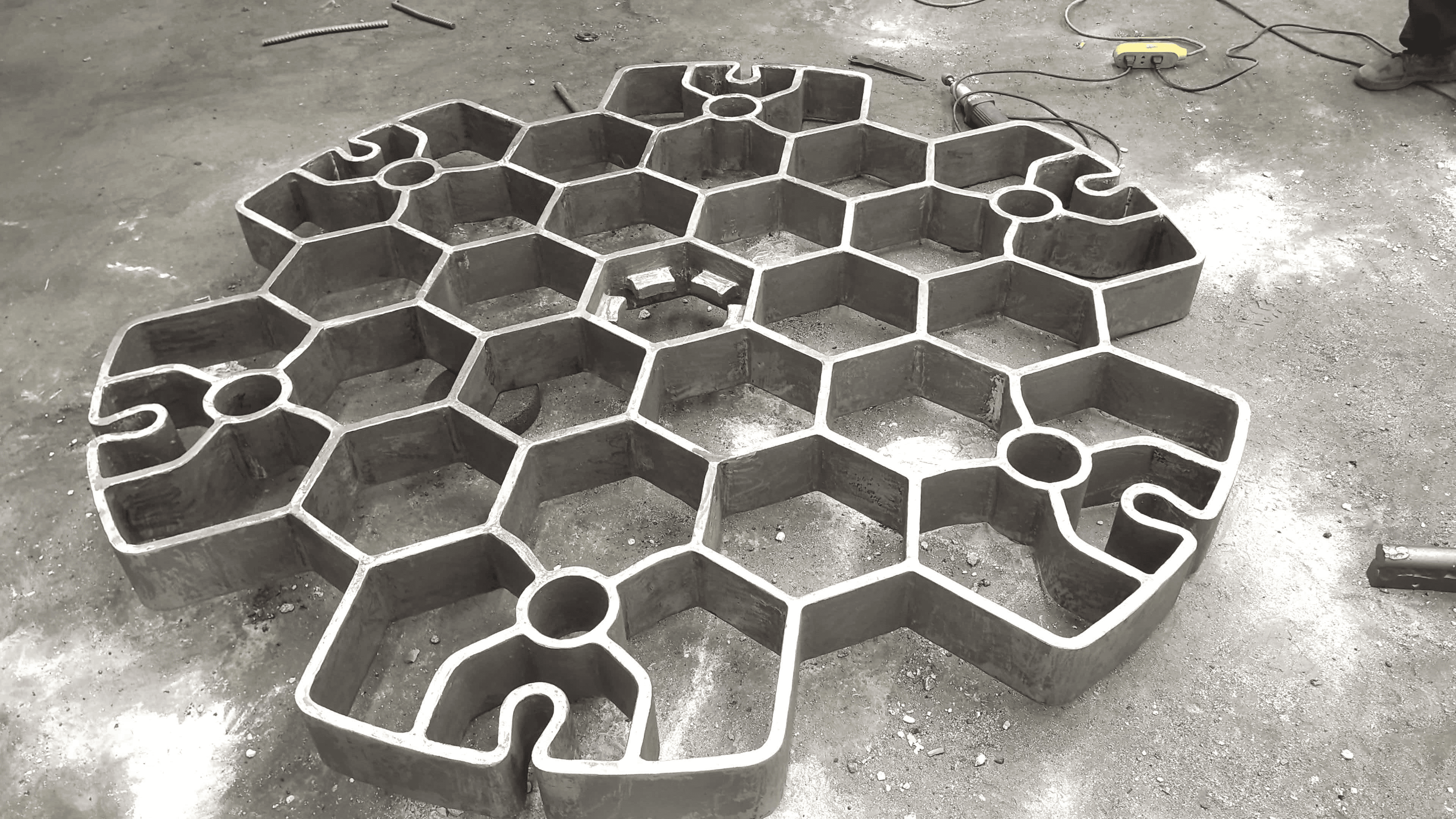
Why heat treatment fixture sourcing is being re-examined
Heat treatment fixtures are the load-bearing interface between a furnace and the parts inside it. Charge trays and charge racks carry workpieces through heating and cooling cycles, so their geometry, alloy, and condition directly affect how parts sit, how atmosphere circulates, and how often fixtures must be replaced. Buyers who once treated fixtures as a commodity item are increasingly reviewing them alongside furnace loading practice and part-quality requirements.
The shift is less about a single market event than about several pressures arriving together: tighter part tolerances, more varied load patterns, and a preference for fixtures engineered from drawings rather than picked from a catalogue. This article separates what can be observed in fixture specifications from what remains an inference, and turns each trend into a decision the buyer can act on.
Trend 1: fixtures are specified from drawings, not stock sizes
The clearest change in fixture procurement is the move toward drawing-based geometry. A heat-resistant steel charge tray is now commonly developed around the customer drawing, the load pattern, the operating temperature, and the handling method, rather than selected from a fixed size range. The same applies to charge racks, which are engineered from customer drawings to suit furnace space, workpiece arrangement, loading methods, and thermal conditions.
What this means for buyers
- Drawing quality becomes a procurement input. A fixture can only be reviewed against what the drawing shows. Incomplete dimensions, undefined support points, or missing load information push risk back onto the buyer.
- Load pattern matters as much as size. Two trays with the same footprint can behave differently if one distributes weight across a supported span and the other concentrates it.
- Handling is part of the design brief. Lifting points, fork access, and stacking arrangements affect how a fixture is used in practice, not just how it looks on paper.
The practical implication is that fixture inquiries are becoming more document-heavy. Buyers who can supply a clear drawing, a load description, and confirmed thermal conditions get a more useful engineering response than those who ask for a generic tray.
Trend 2: alloy selection is tied to confirmed operating conditions
Heat-resistant alloy steel construction is standard for charge trays and racks, but the specific alloy is a decision, not a default. Suppliers that work from drawings typically select heat-resistant alloy against confirmed conditions rather than quoting a single grade for every furnace.
Two product-level requirements recur in fixture specifications: oxidation resistance and deformation resistance at elevated temperatures. Both are properties of the alloy and the geometry together. A tray designed for oxidation and deformation resistance at elevated temperatures still depends on section thickness, support spacing, and how the load is distributed.
Decision rule for alloy conversations
Before discussing grade, confirm the operating temperature, the atmosphere, the cycle profile, and the load. Without those four inputs, an alloy recommendation is an assumption. Buyers should treat any grade suggestion offered before these conditions are confirmed as provisional.
Trend 3: open structures are favoured for circulation
Charge racks with an open configuration are specified to support circulation around the loaded parts. This is a functional choice, not an aesthetic one: an open structure lets the furnace atmosphere reach the workpieces, while a more closed base changes how heat and gas move through the load.
The trade-off is familiar to anyone who has compared grid and solid base trays. Open geometry supports circulation but can concentrate stress at connection points; solid geometry distributes load differently but can obstruct flow. Neither is universally better. The right answer depends on the part geometry, the atmosphere, and the quench or cooling path the process requires.
| Fixture attribute | What it affects | What the buyer must confirm |
|---|---|---|
| Open vs. closed load surface | Atmosphere circulation around parts | Part geometry and required flow path |
| Support geometry | How workpieces sit and are restrained | Workpiece arrangement and contact limits |
| Alloy choice | Oxidation and deformation behaviour at temperature | Operating temperature, atmosphere, cycle profile |
| Handling features | Lifting, stacking, and furnace loading | Loading method and furnace space |
Trend 4: large-format, heavy-duty furnace loads
Charge trays are available for large-format heavy-duty furnace applications, and inquiries increasingly reflect that. Larger fixtures amplify the consequences of design choices: a small geometry error or an under-specified support span becomes a deformation problem at scale.
For buyers, this raises the value of an early geometry review. A drawing-based geometry review before production is the point where support spacing, section transitions, and handling features can still be adjusted. Once a large tray is cast, correction options narrow sharply.
Trend 5: inspection scope is set per order
Fixture buyers are asking more often what will be checked and recorded on their specific order. Order-specific production and inspection scope is the relevant concept here: rather than a generic quality statement, the scope is defined for the order in question.
This is a useful trend for procurement because it moves the conversation from assurances to specifics. Buyers should ask which characteristics will be inspected, at what stage, and what record they will receive. Where a supplier cannot state this before order placement, that is a signal to clarify scope first.
What has not changed
Some fundamentals remain stable regardless of sourcing trends. Fixtures still fail through oxidation, thermal fatigue, and deformation, and those failure modes still trace back to the match between alloy, geometry, and service conditions. Applications across metallurgy, power, petrochemical, mining, and heat treatment continue to dominate demand, and each brings its own load and atmosphere profile.
What has changed is the expectation that these factors be documented and reviewed before a fixture is made, rather than discovered after it is in service.
A practical checklist for fixture buyers
- Provide a dimensioned drawing with support points and load distribution marked.
- State operating temperature, atmosphere, and cycle profile explicitly.
- Describe the loading and handling method, including lifting and stacking.
- Confirm furnace space and any clearance constraints.
- Agree the inspection scope and records before order placement.
- Ask for a geometry review response against your drawing, not a catalogue match.
Buyers evaluating heat-resistant steel charge trays or charge racks can use these points as the basis of an inquiry. The quality of the response will usually track the quality of the inputs provided.