
Heat-Resistant Steel Charge Tray Buyer's Guide: Specification, Supplier, and Order Checks
A procurement guide to specifying, comparing, and validating custom cast heat-resistant steel charge trays for furnace loading, with the questions and evidence to request before ordering.
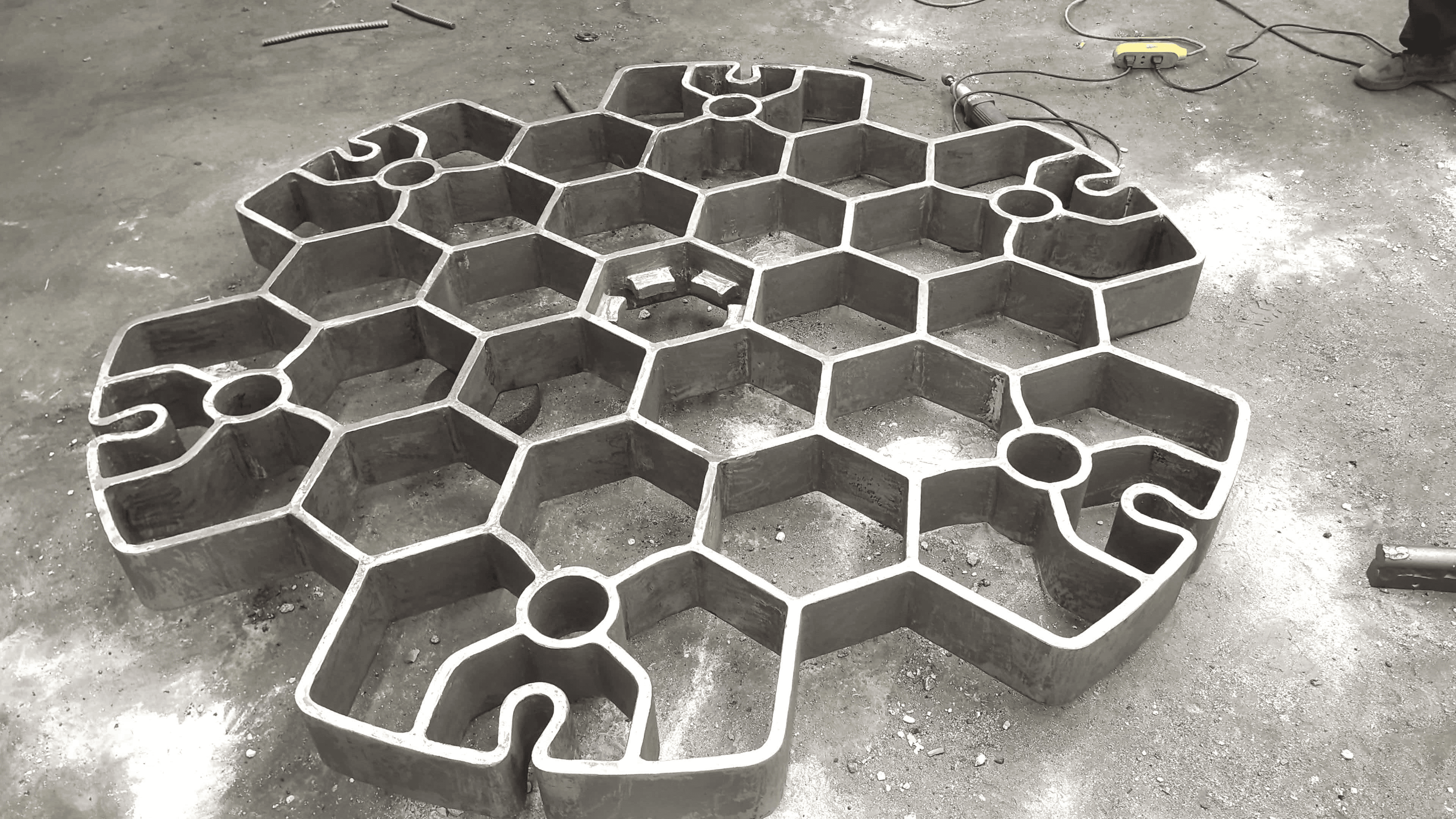
What a charge tray has to do before price matters
A heat-resistant steel charge tray is a cast fixture that carries workpieces through a high-temperature furnace cycle. It has to hold the load, keep its shape, resist oxidation at the operating temperature, and allow heat and atmosphere to reach the parts. It also has to survive handling between cycles. Those jobs are mechanical, thermal, and logistical at the same time, which is why a tray that looks similar on a drawing can behave very differently in service.
This guide is written for buyers moving from a rough requirement to a supplier comparison. It covers the inputs a foundry needs, the trade-offs behind geometry and alloy choice, the evidence to request, and the checks that catch problems before a full order is released. It applies to cast trays and charge racks used in metallurgy, power, petrochemical, mining, and general heat-treatment operations.
One boundary up front: the right tray cannot be selected from a temperature number alone. Load pattern, support spacing, cycle time, atmosphere, handling method, and furnace dimensions all change the answer. Treat any quotation offered without those inputs as provisional.
Start with the furnace and the load, not the alloy
Alloy selection is usually the most technical conversation, but it should come after the operating envelope is fixed. A supplier who starts with a grade recommendation before asking about the furnace is guessing. Build the requirement in this order.
Operating conditions
- Peak and normal operating temperature, stated separately. A tray that sees 1,050 °C for a short cycle is a different problem from one held at 900 °C for many hours.
- Cycle profile: heating rate, hold time, cooling rate, and whether cooling is in air, forced gas, or a quench.
- Atmosphere: air, endothermic or exothermic gas, nitrogen, hydrogen, vacuum, or combustion products. Sulphur and other contaminants matter if present.
- Thermal cycling frequency. Repeated heating and cooling drives distortion and cracking more than a steady hold.
Load and geometry
- Workpiece weight, dimensions, and how many sit on each tray.
- Whether the load is evenly distributed or concentrated at a few points.
- Required support positions and any contact areas that must be avoided to prevent marking or distortion of the parts.
- Clearance to furnace walls, heating elements, and door openings.
Handling and furnace interface
- How the tray is moved: forklift, crane, roller hearth, pusher, or manual loading.
- Pick-up points and whether the tray needs feet, rails, lugs, or lifting features.
- Stacking: single layer, stacked trays, or trays used as part of a rack assembly.
Write these down as a single conditions sheet and send the same sheet to every supplier you compare. It is the only way to judge whether quotations are answering the same question.
Geometry decisions that drive tray life
Charge tray geometry is a balance between stiffness and thermal freedom. A stiff tray resists load deflection but may crack when it cannot expand and contract. A flexible tray survives cycling but may sag under load. The right compromise depends on the load pattern and cycle.
Open structures are common in charge racks because they let hot gas circulate around the workpieces and reduce mass. The trade-off is that open sections concentrate stress at connections and can distort if the load is not supported where the designer expected. Solid or grid bases each have their own heat-distribution behaviour, and the choice should follow the part geometry and the required temperature uniformity, not a default preference.
| Design decision | What it favours | What to watch |
|---|---|---|
| Open frame or grid | Atmosphere circulation, lower mass, faster heating | Stress concentration at joints; load must sit on intended supports |
| Solid or heavy base | Support for concentrated or uneven loads | More mass to heat; slower response; check heat-up impact on cycle |
| Ribs and stiffeners | Resistance to sag over long spans | Restrained expansion can cause cracking if not designed for cycling |
| Feet, rails, or lugs | Handling and furnace interface | Local stress and wear points; confirm lifting method |
Ask the supplier to show how the geometry was reviewed against your drawing: support spacing, section thickness, and how the tray is expected to expand. A drawing-based geometry review is a normal part of custom cast fixture work, and it should be documented rather than implied.
Alloy and casting route: what to confirm
Heat-resistant alloy selection is a trade-off between temperature capability, oxidation resistance, strength, castability, and cost. The supplier should select the grade against confirmed conditions, not against a generic temperature band. Ask for the proposed grade in writing, the basis for the recommendation, and any limitation on its use in your atmosphere.
For cast trays, the casting route also matters. Wall thickness, section transitions, and feeding design affect soundness. A geometry that is easy to machine may be difficult to cast without porosity, and a supplier should flag that before quoting rather than after the first cast.
Request the inspection scope in the quotation. Typical order-specific checks can include dimensional verification against the drawing, visual examination, and chemical composition confirmation. Non-destructive examination, hardness, or other tests should be stated explicitly if you need them; do not assume they are included.
Supplier evaluation: questions that separate real capability from a catalogue
Most suppliers can show a photo of a tray. Fewer can explain how they will make yours. Use the following questions in the first technical exchange and compare the quality of the answers, not just the price.
- Which inputs do you need before you can recommend an alloy, and which of those are mandatory?
- Can you show a geometry review against our drawing, including support and expansion considerations?
- What is your proposed casting route, and what limitations does our geometry create?
- What inspection and documentation will be included in this order, and what is optional?
- How do you handle first-article approval and changes after approval?
- What packing and marking will protect the tray in transit and allow identification on arrival?
Be cautious with suppliers who quote a firm price and delivery without asking about atmosphere, load pattern, or handling. That is a sign the quotation is based on a generic tray, not your application. Equally, treat claims of extremely long service life without a stated basis as marketing rather than evidence.
Sample, first article, and order validation
For a custom cast fixture, the first article is the real test. Agree before production on what will be measured, how it will be measured, and what constitutes acceptance. A practical sequence:
- Drawing review: confirm dimensions, tolerances, and any critical features. Resolve open questions in writing.
- First article: check dimensions, visual condition, and fit against the furnace interface or a representative workpiece.
- Condition trial: where practical, run the tray through a representative cycle with a representative load and inspect for distortion or cracking.
- Production release: only after the first article is accepted, with the approved drawing and inspection scope recorded.
Keep the approved drawing as the controlled reference for the order. If the supplier proposes a change after approval, require a written deviation with the reason and the effect on fit or performance.
Warning signs in a quotation or supplier response
- An alloy grade named without any question about temperature, atmosphere, or cycle.
- No stated inspection scope, or inspection described only as "standard".
- Delivery or price offered before the drawing and conditions are reviewed.
- Unwillingness to document the geometry review or first-article criteria.
- Claims of performance that are not tied to your operating conditions.
None of these is automatically disqualifying, but each one shifts risk to the buyer. Ask for the missing information before comparing commercial terms.
Next steps for a buyer
Prepare a one-page conditions sheet covering temperature, cycle, atmosphere, load, handling, and furnace interface. Send it with your drawing to two or three suppliers and ask each to respond to the same questions. Compare the technical responses first, then the commercial terms. For custom cast charge trays and heat-treatment fixtures, the supplier's ability to review geometry and select an alloy against confirmed conditions is the capability that matters most; the price only becomes meaningful once that is established.