
Heat-Resistant Steel Charge Rack: A Buyer's Guide to Specification and Verification
How to specify a heat-resistant steel charge rack: define the thermal and load envelope, select alloy and geometry, verify casting quality, and avoid common procurement mistakes.
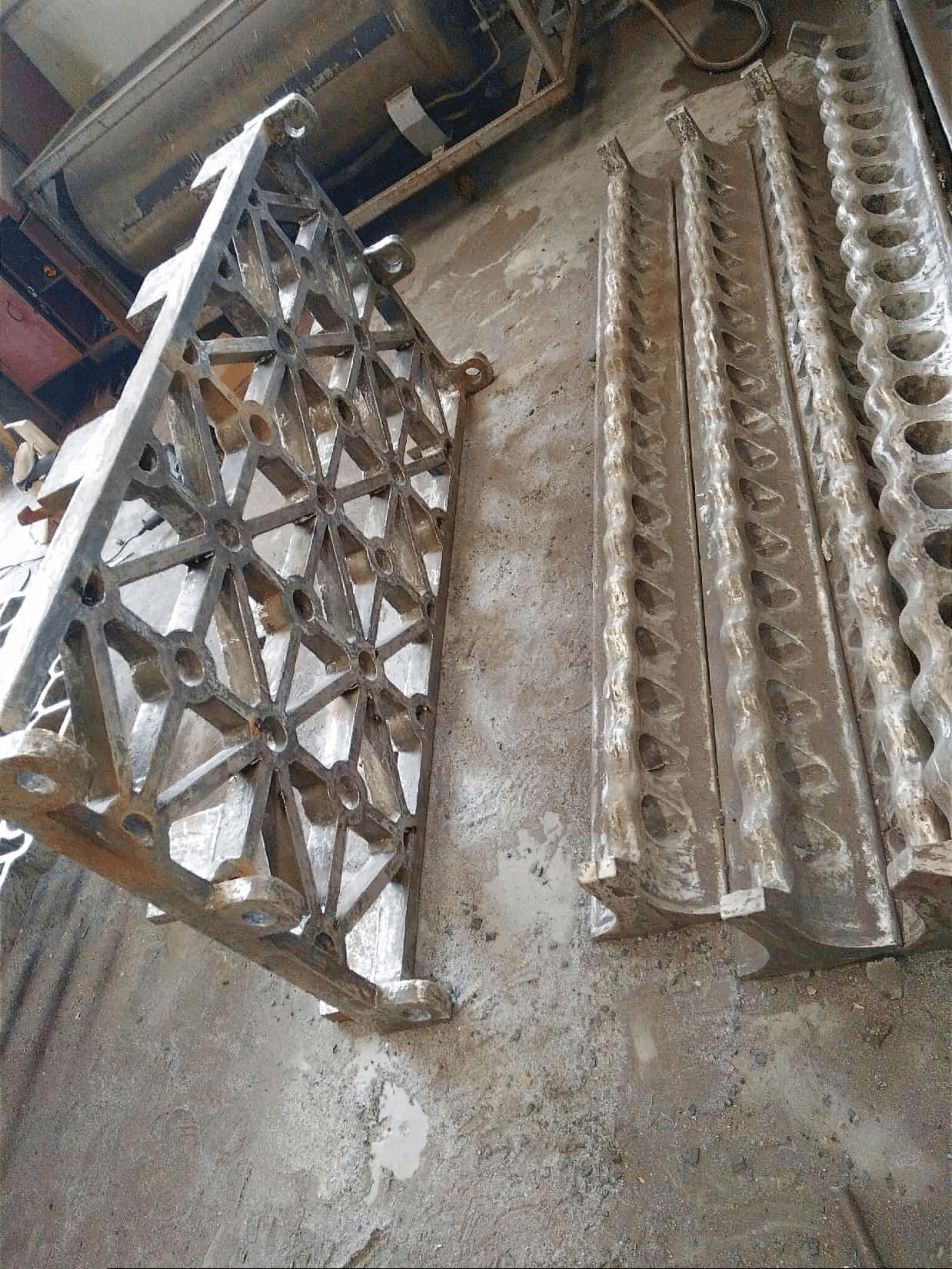
What a charge rack does and when it is the right fixture
A heat-resistant steel charge rack is a cast fixture that positions and supports workpieces through high-temperature furnace cycles. It is not a container; it is a structural interface between the furnace, the load, and the handling equipment. The rack's job is to hold parts in the intended orientation, keep them stable during loading and unloading, and allow the furnace atmosphere to circulate around the load.
Charge racks are typically considered when the part geometry or quench path makes a flat tray a poor fit. If parts need to stand, hang, nest, or be spaced apart for uniform heating and cooling, a rack with custom support geometry usually outperforms a solid or grid tray. If the load is flat and dense, a heat-resistant steel charge tray is often the simpler and more economical choice. The two fixture types are complementary, not interchangeable.
The rack is engineered from customer drawings around four inputs: furnace space, workpiece arrangement, loading method, and thermal conditions. Get any of those wrong and the fixture may fit the drawing but fail in service.
Define the operating envelope before you request a quote
Most charge rack problems trace back to an incomplete operating envelope. The supplier can only select alloy and geometry against conditions that are confirmed and written down. Before approaching a foundry, assemble the following data. Where a value is unknown, mark it as unknown rather than guessing.
- Peak service temperature and cycle profile. The maximum temperature the rack sees, how long it holds there, and how often the cycle repeats. Thermal cycling is often more damaging than a steady soak.
- Atmosphere. Air, endothermic gas, nitrogen, hydrogen, vacuum, or combustion products. Oxidation, carburization, and nitriding risks depend on this.
- Load. Total load weight, the weight borne by each support point, and whether the load is static or shifted during handling.
- Furnace interface. Usable hearth or basket dimensions, clearances to heating elements and walls, and any locating features the rack must engage.
- Handling method. Forklift, crane, robot, or manual. Handling loads can exceed service loads and often govern the structural design.
- Quench path. Whether the rack goes into oil, water, polymer, or gas, and the temperature drop involved. Quench introduces severe thermal shock.
- Expected service life and replacement strategy. A rack that is inspected and replaced on a schedule can be designed differently from one expected to run until visible failure.
Write these values into the inquiry. A drawing alone does not tell the foundry what the rack will experience.
Alloy selection: match the grade to the confirmed conditions
Heat-resistant alloy selection is a trade-off between temperature capability, oxidation resistance, creep strength, thermal fatigue resistance, castability, and cost. There is no universal "best" grade. The right choice depends on the envelope you defined above.
Heat-resistant alloy steels and stainless grades are the common family for charge racks. Within that family, higher nickel and chromium content generally improves high-temperature oxidation resistance and creep strength, but also raises cost and can affect castability and weldability. The supplier should recommend a grade against confirmed conditions, not against a generic temperature rating.
| Condition | What it stresses | Alloy direction to discuss |
|---|---|---|
| Continuous high-temperature soak in air | Oxidation, scaling, creep | Higher chromium and nickel for oxidation resistance and creep strength |
| Frequent thermal cycling | Thermal fatigue cracking | Grades with good thermal fatigue resistance; geometry that avoids sharp section changes |
| Carburizing or nitriding atmosphere | Surface degradation, embrittlement | Grades resistant to the specific atmosphere; confirm with the supplier |
| Quench from high temperature | Thermal shock, distortion | Grades and sections that tolerate rapid temperature change |
| Heavy load at temperature | Creep deformation | Higher creep strength; thicker sections or added supports |
Ask the supplier to state which grade they propose and why, referencing your confirmed temperature, atmosphere, and load. If the answer is a grade name without reasoning, treat it as unverified.
Geometry: design for circulation, handling, and casting
A charge rack's open configuration is functional, not cosmetic. Open structure lets the furnace atmosphere reach the workpieces, which supports uniform heating and cooling. But openness must be balanced against stiffness, because a rack that deflects under load at temperature can drop parts or jam in the furnace.
Several geometry decisions recur across applications:
- Support points. Fewer, well-placed supports reduce contact marks and thermal mass; more supports reduce point loading. The right number depends on part stiffness and allowable distortion.
- Section transitions. Sharp changes in cross-section concentrate thermal stress. Generous fillets and gradual transitions improve thermal fatigue life.
- Draft and castability. A geometry that is easy to machine may be difficult to cast. Involve the foundry early so the design is castable without compromising function.
- Handling features. Lifting points, fork pockets, or crane lugs should be designed for the handling method and the loaded weight, not added as an afterthought.
- Furnace clearance. Confirm the rack fits the usable furnace space with allowance for thermal expansion and any distortion during service.
This is where drawing-based geometry review earns its place. A foundry that reviews the drawing against casting practice and thermal conditions can flag thin sections, sharp corners, and unsupported spans before the pattern is made.
Charge rack vs. charge tray: a decision rule
Buyers often ask which fixture type to choose. The decision usually comes down to part orientation and circulation needs.
| Factor | Charge rack | Charge tray |
|---|---|---|
| Part orientation | Parts stand, hang, nest, or need spacing | Parts lie flat or in a dense layer |
| Atmosphere circulation | Open structure promotes flow around parts | Perforated or grid trays provide flow; solid trays rely on edge access |
| Load density | Lower density, more spacing | Higher density, larger batches |
| Geometry complexity | Custom support geometry per part family | Simpler, more standardized footprint |
| Typical use | Distortion-sensitive or vertically oriented parts | Flat parts, bulk loads, general furnace loading |
Decision rule: if the part's heat-treat response depends on orientation or on atmosphere reaching specific surfaces, start with a rack. If the part is flat and the batch is dense, start with a tray. Some loads use both: a tray as the base and a rack as the part-positioning layer.
Inspection and acceptance: what to verify before the rack enters service
Order-specific production and inspection scope should be agreed in writing before casting. The exact tests depend on the grade and application, but the following checks are commonly relevant for heat treatment fixtures. Confirm with the supplier which apply to your order.
- Material certification. Chemistry and grade confirmation against the agreed specification.
- Dimensional inspection. Critical dimensions, support locations, and furnace interface features checked against the drawing.
- Visual and surface inspection. Casting defects such as porosity, cracks, and cold shuts in load-bearing or high-stress regions.
- Non-destructive examination where specified. Radiography, dye penetrant, or other methods for critical sections, if agreed.
- Fit check. Where practical, confirm the rack engages the furnace and handling equipment as intended.
Ask for the inspection plan with the quotation, not after delivery. A supplier that cannot describe its inspection scope before production is a risk.
Common procurement mistakes and how to avoid them
Most charge rack failures in service are predictable at the procurement stage. The recurring mistakes are worth naming.
- Specifying by temperature alone. A grade rated for the peak temperature may still fail under thermal cycling, atmosphere attack, or sustained load. Specify the full envelope.
- Copying a drawing without reviewing it. A drawing that worked in one furnace may not suit another furnace's clearance, atmosphere, or handling. Have the foundry review geometry against your conditions.
- Ignoring handling loads. A rack designed only for static service load can deform during crane or forklift handling. State the handling method.
- Treating the rack as a commodity. Charge racks are engineered fixtures. A lowest-price quote that skips geometry review and inspection scope often costs more over the fixture's life.
- No replacement plan. Heat treatment fixtures degrade. Plan inspection intervals and spares so a failed rack does not stop the furnace.
Questions to ask a charge rack supplier
Use these questions to separate a capable foundry from a trader. The answers should be specific to your application, not generic.
- Which alloy grade do you recommend for my confirmed temperature, atmosphere, and load, and why?
- Will you review my drawing for castability and thermal stress before quoting?
- What inspection scope applies to my order, and can you provide the plan with the quotation?
- How do you handle geometry changes if the first casting reveals a problem?
- What information do you need from me that I have not provided?
For international buyers, also confirm documentation language, dimensional units, and shipping terms before the order is placed.
Next step: turn your envelope into an inquiry
A useful inquiry includes the drawing, the operating envelope, the handling method, and the inspection expectations. With those, a foundry can propose a grade and geometry that fit the application rather than guessing. If you are still deciding between a rack and a tray, describe the part orientation and circulation needs and ask for a recommendation with reasoning.