
Heat-Resistant Steel Charge Tray and Rack Specification Guide for Furnace Fixtures
A technical procurement guide to specifying heat-resistant steel charge trays and racks: alloy selection, geometry, casting vs. fabrication, inspection, and total cost of ownership.
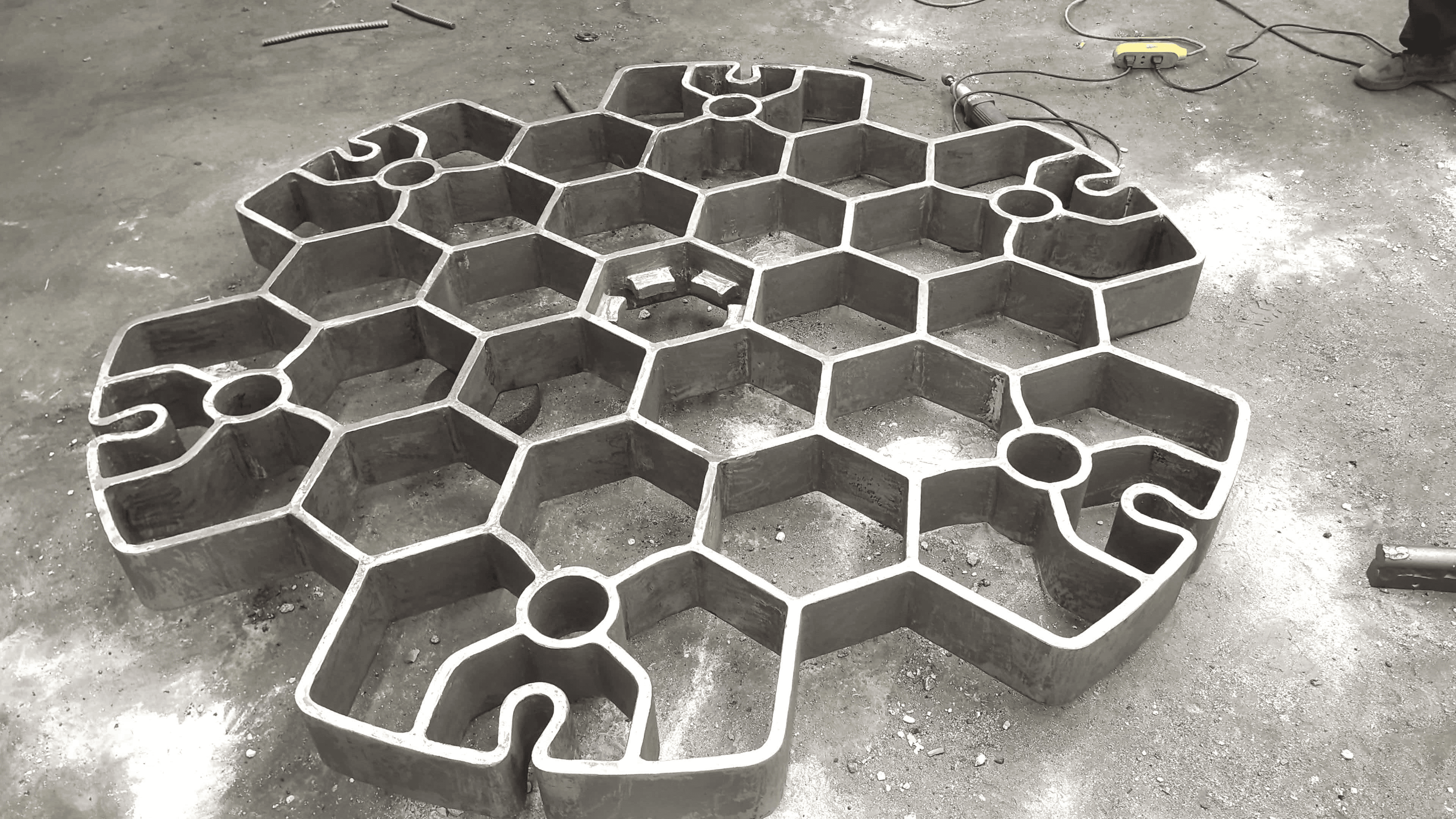
What Charge Trays and Racks Do in a Furnace
Charge trays and charge racks are the reusable fixtures that carry workpieces through heat-treatment furnaces. They sit between the furnace hearth or conveyor and the product, and they must survive the same thermal cycle as the load while remaining dimensionally stable enough to keep parts positioned. In continuous furnaces, a tray may cycle thousands of times; in batch operations, the fixture may be quenched with the load. The fixture is not a passive accessory. It affects heat transfer, atmosphere circulation, loading density, and the frequency of unplanned furnace stops.
This guide is written for engineers and procurement teams evaluating cast heat-resistant steel charge trays and racks. It focuses on the decisions that determine whether a fixture lasts or fails early: alloy grade, geometry, casting versus fabrication, inspection criteria, and how to compare quotations on a like-for-like basis.
Alloy Selection: Matching Grade to Cycle Conditions
Heat-resistant stainless and alloy steels are specified primarily by their ability to form and retain a protective oxide scale at temperature, and by their creep and thermal-fatigue resistance. The operating temperature is only one input. Atmosphere, thermal cycling frequency, load weight, and quench severity all shift the selection.
Temperature and atmosphere
Oxidation resistance generally improves with chromium content, while nickel content supports austenitic stability and high-temperature strength. In carburizing or nitriding atmospheres, the protective oxide scale can be compromised, and alloys with higher nickel and silicon content are often considered. In reducing atmospheres or vacuum, oxide-scale formation is limited, and the selection emphasis shifts toward creep strength and thermal fatigue. Buyers should provide the furnace atmosphere, dew point or carbon potential where relevant, and whether the fixture is exposed to combustion products.
Thermal cycling and quench
Repeated heating and cooling imposes thermal fatigue. Fixtures that are quenched with the load see steeper thermal gradients than fixtures that remain in the hot zone. The alloy selection and the section thickness must be considered together: thin sections heat and cool faster but may distort; thick sections resist distortion but develop higher thermal stresses. The supplier should review the cycle profile, including heating and cooling rates, not just the maximum temperature.
Load and creep
At elevated temperature, fixtures deform by creep under sustained load. The relevant question is not only the alloy's short-term strength but its creep resistance at the actual service temperature and stress. A tray that carries heavy workpieces at 1,100 °C for long holds may need a different grade and section than a rack that carries lighter parts through a shorter cycle. Buyers should state the load per fixture, the support span, and the expected number of cycles.
Geometry and Load Path: Where Fixtures Fail
Most premature fixture failures begin at geometric discontinuities: sharp corners, abrupt section changes, weld toes, and unsupported spans. In cast fixtures, the same principles apply to fillet radii, rib transitions, and the way load is transferred from the workpiece to the fixture and then to the furnace hearth or conveyor.
Support and circulation
An open rack structure allows the furnace atmosphere to circulate around the loaded parts, which supports uniform heating and cooling. A solid tray base may be appropriate for small parts or for loads that need a continuous support surface, but it can block circulation beneath the load. The choice between open and solid configurations should be driven by the part geometry, the required temperature uniformity, and the quench method. The fixture design should also account for the way parts are loaded and unloaded, including whether they are placed manually or by automation.
Distortion control
Fixtures distort when thermal gradients and load stresses exceed the material's resistance. Design measures include symmetric geometry, gradual section transitions, and ribs that carry load in compression rather than bending where possible. For long trays, the support spacing and the hearth condition matter: an uneven hearth can introduce bending that the fixture was not designed to carry. Buyers should confirm the hearth flatness and the support conditions at the furnace.
Handling features
Lifting points, fork pockets, and handling lugs are often the highest-stressed regions because they concentrate load during transfer. Their design should be reviewed against the handling method, including the temperature at which the fixture is handled and whether handling equipment engages the fixture while hot. Cast-in features can reduce the need for welds in these regions.
Casting Versus Fabrication: A Procurement Comparison
Charge trays and racks can be produced as castings, as weldments from plate and section, or as a combination. The right choice depends on geometry complexity, quantity, lead time, and the inspection regime the buyer requires. The table below compares the two approaches on decision factors that affect procurement, not on a claim that one is universally superior.
| Decision factor | Cast fixture | Fabricated fixture |
|---|---|---|
| Geometry freedom | Complex ribs, curved surfaces, and integrated handling features can be formed in the mold. | Limited by plate and section availability; complex shapes require welding and may concentrate stress. |
| Tooling and minimum quantity | Requires a pattern; tooling cost is amortized over the order quantity. | No pattern required; economical for small quantities and simple shapes. |
| Section thickness control | Thickness is set by the pattern and casting process; internal soundness depends on foundry practice. | Thickness is set by the selected plate or section; weld quality depends on fabrication practice. |
| Inspection | Dimensional inspection, visual examination, and volumetric examination where specified; casting soundness is a key acceptance criterion. | Dimensional inspection, weld inspection, and material certification for the plate and consumables. |
| Repair | Repair welding may be permitted under defined conditions; buyer should agree on acceptance criteria before order. | Local repair by welding is common; the repair procedure and post-repair inspection should be agreed. |
| Lead time drivers | Pattern making, molding, casting, heat treatment, and machining where required. | Material procurement, cutting, forming, welding, and stress relief where required. |
The comparison is not a verdict. A simple rectangular tray in low quantity may be more economical as a weldment; a complex rack with integrated supports and repeated annual demand may justify casting tooling. Buyers should ask each supplier to state which route they propose and why, and then compare the inspection scope that comes with each route.
Specification Checklist for RFQs
A drawing alone is rarely enough to get comparable quotations for heat-treatment fixtures. The following information should be included in the request for quotation so that suppliers can select alloy and geometry against the same conditions.
- Operating temperature: maximum and typical, including any excursions.
- Atmosphere: air, endothermic, exothermic, nitrogen, vacuum, carburizing, or other; include dew point or carbon potential where controlled.
- Cycle profile: heating and cooling rates, hold time, and whether the fixture is quenched with the load.
- Load: weight per fixture, load distribution, and support span.
- Furnace interface: hearth type, conveyor or roller dimensions, and support spacing.
- Handling: lifting method, fork pockets, and whether handling occurs at temperature.
- Quantity and demand pattern: first order and expected annual usage.
- Inspection and documentation: dimensional report, material certification, visual and volumetric examination, and any third-party inspection requirements.
- Acceptance criteria: allowable distortion, surface condition, and repair policy.
Where the buyer does not specify an alloy, the supplier should state the proposed grade and the basis for the selection. That basis should reference the confirmed conditions, not a generic temperature rating.
Inspection and Verification at Receipt
Incoming inspection should be matched to the failure modes that matter for the fixture. Dimensional checks confirm that the fixture fits the furnace and the handling equipment. Visual examination looks for surface defects, cracks, and evidence of repair. Where the buyer has specified volumetric examination, the report should identify the method, coverage, and acceptance criteria.
Material certification should be reviewed against the specified grade and the heat treatment condition. For cast fixtures, the buyer should confirm whether the supplier's inspection scope includes casting soundness and how repairs are handled. For fabricated fixtures, weld inspection and stress-relief records are relevant. The inspection plan should be agreed before production, not after delivery.
First-article inspection is particularly useful for new geometries. It establishes a dimensional baseline that can be used for subsequent orders and for evaluating distortion after service.
Total Cost of Ownership: What to Compare Beyond Price
The purchase price of a charge tray or rack is a small part of its cost if the fixture fails early. A realistic comparison includes the number of cycles the fixture is expected to survive, the cost of replacement, and the cost of the furnace downtime required to change it. Fixtures that distort can also cause part distortion, scrap, and rework, which are often larger costs than the fixture itself.
Buyers should ask suppliers to state the basis for their expected service life, including the alloy, the section thickness, and the assumed operating conditions. A supplier that cannot explain the basis is offering an estimate, not an engineering judgment. It is also reasonable to ask for the inspection records that will accompany the order and to compare those records across quotations.
Common Failure Modes and Their Causes
- Oxidation and scaling: often linked to alloy grade, temperature, and atmosphere; accelerated by thermal cycling that spalls the protective scale.
- Creep sag: sustained load at temperature with insufficient section or support; more likely in long unsupported spans.
- Thermal fatigue cracking: repeated rapid heating and cooling, especially at geometric discontinuities and weld toes.
- Distortion: asymmetric geometry, uneven hearth support, or handling while hot.
- Casting defects: porosity or shrinkage that reduces effective section; acceptance criteria and inspection scope determine whether these are detected.
Each failure mode points back to a specification decision. A buyer who provides the operating conditions and agrees on inspection criteria gives the supplier a defensible basis for design and gives the plant a fixture that can be evaluated against a known standard.
Working with a Charge Tray Supplier
For drawing-based cast charge trays and racks, the supplier's role includes reviewing the drawing against the stated conditions, proposing an alloy, and defining the production and inspection scope for the order. The buyer's role is to provide accurate operating conditions and to agree on acceptance criteria before production. A supplier that asks for the cycle profile, atmosphere, and load data is doing the work that prevents early failure; a supplier that quotes from a drawing alone is leaving those decisions to chance.
Requests for quotation can be sent through chuangtecasting.com with the specification checklist above. Including the furnace interface dimensions and the handling method at the first inquiry reduces the back-and-forth that delays order-specific production.