
A Technical Guide to Heat Treatment Trays and Furnace Fixtures
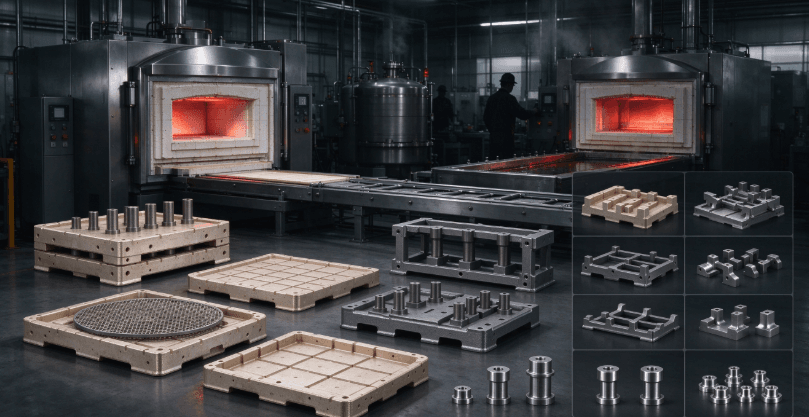
Table of Contents
1. Core Functions in the Quenching Process
1.1. Dealing with Thermal Fatigue Resistance
1.2. Load Bearing at High Temperatures
2. High Temperature Alloy Material Choices
2.1. HT Alloy Properties
2.2. HU Alloy Upgrades
3. Data Comparison: HT Alloy vs. HU Alloy
4. Handling Carbon in the Carburizing Furnace
4.1. Resisting Carbon Penetration
4.2. Dealing with Reversible Tray Designs
5. Design Rules for Continuous Furnace Systems
5.1. Airflow and Grid Design
6. The Investment Casting Advantage
7. Industry FAQ
Metal parts need heat to get hard. You put them in a hot oven. But you can not just throw them inside. You need heat treatment trays. These trays hold the metal parts. They go into the fire together.
The furnace gets very hot. Sometimes it is over 1000 degrees Celsius. The tray must survive this heat. It must not melt. It must not bend. If the tray bends, the metal parts on it will fall. This ruins the whole batch.
We look at how these trays work. We look at the metal they use. We use basic facts. We do not use big empty marketing words. You need these facts to build good furnace setups. Bad trays cause machine jams. Good trays keep the factory running.
1. Core Functions in the Quenching Process
The tray does more than just sit there. It has to handle extreme changes. The hardest part of the job is the cooling step.
1.1. Dealing with Thermal Fatigue Resistance
When you heat metal, it gets big. When you cool it, it gets small. The quenching process is very fast. You take the red-hot tray out of the oven. You drop it into cold oil or water.
This causes massive stress. The metal shocks. We call this thermal shock. Over time, this makes cracks in the tray. Good heat treatment trays have high thermal fatigue resistance. They can shrink and grow many times before they crack. You want the tray to last thousands of cycles.
1.2. Load Bearing at High Temperatures
Steel gets soft when it is hot. But the tray must carry heavy gears and steel shafts. It must hold the weight without sagging. This is called creep strength.
Engineers design cast steel fixtures with thick ribs. The ribs give it a strong skeleton. If the ribs are too thin, the tray bends in the middle. We call this distortion. A distorted tray jams the machine. It gets stuck on the rails.
2. High Temperature Alloy Material Choices
You can not use normal steel for furnace baskets. Normal steel burns up. It turns to dust very fast. You must use a high temperature alloy. These alloys have a lot of nickel and chromium.
2.1. HT Alloy Properties
HT alloy is very common in foundries. It has about 35% nickel and 15% chromium. It is good for normal hardening jobs. It works well up to 1050 degrees Celsius.
But HT alloy does not like sulfur. If your furnace gas has high sulfur, the tray will die fast. The sulfur eats the nickel. So you have to know what gas you are using.
2.2. HU Alloy Upgrades
HU alloy has more nickel inside it. It has about 39% nickel and 18% chromium. It handles higher heat. It survives up to 1100 degrees Celsius.
It costs more money to buy. But it lasts longer in severe quenching. Factories use HU alloy when they have very heavy loads. It does not warp as easy as HT.
3. Data Comparison: HT Alloy vs. HU Alloy
We use numbers to show the difference. Factory engineers use these numbers to pick the right metal. You balance the cost against the heat limits.
This data comes from standard metallurgical testing. It follows the ASTM A297 casting specifications for heat-resistant alloys.
Feature | HT Alloy Castings | HU Alloy Castings |
Nickel Content Range | 33.0% - 37.0% | 37.0% - 41.0% |
Chromium Content Range | 13.0% - 17.0% | 17.0% - 21.0% |
Max Operating Temperature | 1050°C (1920°F) | 1100°C (2010°F) |
Thermal Fatigue Resistance | Standard level | High level |
Severe Quenching Ability | Moderate | Excellent |
Carbon Attack Resistance | Good | Very Good |
Note: Actual working limits change based on the exact weight of the parts sitting on the tray.
4. Handling Carbon in the Carburizing Furnace
Sometimes you do not just heat the parts. You add chemicals to the air inside the furnace. This makes the job harder for the trays.
4.1. Resisting Carbon Penetration
When you do case hardening, you pump carbon gas into the furnace. The carbon goes into your steel parts to make them hard. But the carbon also attacks the heat treatment trays.
If the tray absorbs too much carbon, it gets very brittle. It breaks like glass when you drop it. High nickel alloys resist this carbon attack. The high nickel stops the carbon from going deep into the tray metal.
4.2. Dealing with Reversible Tray Designs
When a tray gets hot and holds heavy weight for months, it slowly bends down. It sags. To fix this, workers flip the tray over. They do this every few months.
This is called a reversible design. Both sides are flat and look the same. When it bends down, you flip it. Then the heat and the weight make it bend back straight. It doubles the life of the cast steel fixtures.
5. Design Rules for Continuous Furnace Systems
Continuous furnace systems do not stop. They push trays in one side. They pull them out the other side. A big mechanical arm pushes them. The trays push against each other in a long line.
5.1. Airflow and Grid Design
The heat must touch the metal parts evenly. The quenching oil must flow around them fast. So the trays have holes. They look like a grid.
If the holes are too small, the oil does not flow fast. The metal parts do not cool right. They stay soft. If the holes are too big, small parts fall through and get lost. Engineers calculate the open space carefully. They make the grid perfect for the specific parts. The pusher arm needs a strong solid edge to push against, so the outside frame is always thick.
6. The Investment Casting Advantage
Some cheap furnace baskets are made from welded steel bars. But welds break in the heat. A weld is a weak point. The metal pulls apart when it cools down.
Smart factories use investment casting for their trays. They pour hot liquid alloy into a single sand or ceramic mold. The tray comes out in one solid piece. There are no welds anywhere.
The joints are smooth and curved. A curved joint handles thermal shock much better than a sharp corner. Investment casting makes the tray live much longer. It costs more at the start, but saves money because it does not break.
7. Industry FAQ
What is the best way to stack parts on the tray?
You must leave space between parts. If they touch, the heat does not reach the middle. The parts will have soft spots. Use small cast pins or wire mesh grids to hold the parts apart. The oil needs room to move.
Why do my furnace baskets crack in the corners?
Corners take the most stress during quenching. If the corner is sharp, it cracks first. Good trays have large radius corners. A round corner spreads the stress out safely. Check your design for sharp 90-degree angles.
Can I fix a broken tray with welding?
You can, but it is a short-term fix. The metal is old and tired from the heat. It is full of carbon. The weld will probably crack again in a few weeks. It is usually better to melt the old tray and cast a new one.
How long should a good tray last?
It completely depends on the quenching process. If you quench in cold water, the tray takes heavy damage. It might last 6 months. If you quench in slow gas or warm oil, the tray can last 2 or 3 years easily.
Does the weight of the tray matter?
Yes. A heavy tray takes a lot of energy to heat up. You pay for gas or electricity to heat the heavy metal tray, not just your parts. A lighter tray design saves energy money. But it must be strong enough to hold the load without bending.