
A Technical Guide to Heat Resistant Furnace Racks and Alloy Fixtures
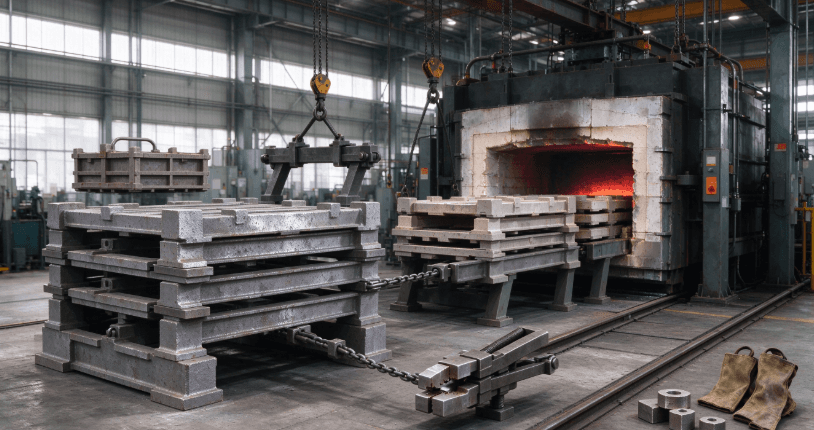
Table of Contents
1. Core Mechanics of the Quenching Process
1.1. Fighting Thermal Fatigue
1.2. Managing Heavy Loads and Creep Strength
2. Choosing High Temperature Alloy Materials
2.1. The Role of Nickel and Chromium
2.2. Surviving the Carburizing Furnace Environment
3. Data Comparison: Common Alloy Grades
4. Structural Design for Furnace Efficiency
4.1. Heat Treatment Grid Layout
4.2. Reversible Rack Designs
5. The Casting Production Method
6. Industry FAQ
Steel parts need heat to get strong. You put them in a massive oven. But they can not sit on the bare floor. You need heat resistant furnace racks. These racks carry the gears, shafts, and pipes. They go into the fire together.
The heat is extreme. Over 1000 degrees Celsius is normal everyday work. The rack must not melt. It must not bend under the heavy weight. If a rack fails, the metal parts fall off. This breaks the machine and ruins the steel. We look at how these racks work. We look at the metal physics.
No big marketing words here. Just straight factory facts. You need these facts to run a safe heat treatment room. Bad racks cost a lot of money in lost time.
1. Core Mechanics of the Quenching Process
The rack does heavy lifting. It goes through big temperature changes fast. The hardest part is the quenching process.
1.1. Fighting Thermal Fatigue
When you heat metal, it gets bigger. When you cool it fast, it gets smaller. The quenching process is brutal. You pull the hot rack out of the fire. You drop it straight into cold oil or cold water.
This makes a big shock. We call it thermal shock. A bad rack cracks in half. Good heat resistant furnace racks have high thermal fatigue resistance. They can shrink and expand hundreds of times without breaking. You want the rack to last years. You do not want it to break in weeks.
1.2. Managing Heavy Loads and Creep Strength
Hot steel gets very soft. But the rack holds maybe 500 kilograms of parts. It has to stay flat. This is about creep strength. Creep is when metal slowly bends under weight when it is hot.
Engineers make thick ribs on the bottom of the rack. The ribs act like a strong skeleton. If the ribs are thin, the rack sags in the middle. A sagging rack gets stuck in the oven rails. It jams the continuous furnace line. It is a big headache for the workers.
2. Choosing High Temperature Alloy Materials
You can not use plain carbon steel. Plain steel burns to ash in the oven. You must use high temperature alloy fixtures. These use special metals mixed together.
2.1. The Role of Nickel and Chromium
The main mix is nickel and chromium. Chromium stops the rust and scaling. Scaling is when the metal flakes off like dry skin. Nickel makes the metal tough. It stops the tiny cracks from spreading.
A common mix is 35% nickel and 15% chromium. We call this HT alloy. This works for basic jobs. It is good up to 1050 degrees Celsius. But HT alloy hates sulfur gas. Sulfur eats the nickel fast.
2.2. Surviving the Carburizing Furnace Environment
Sometimes you do case hardening. This happens in a carburizing furnace environment. You pump carbon gas into the hot oven. The carbon goes into your steel parts. But it also attacks the rack.
It makes the rack brittle like glass. If you drop it, it shatters. For this, you need more nickel. Maybe 39% nickel. We call this HU alloy. High nickel blocks the carbon gas. It keeps the rack tough inside the gas oven.
3. Data Comparison: Common Alloy Grades
Numbers tell the truth. Factory engineers look at the data sheet before they buy. We compare standard alloy grades for high heat. You have to match the metal to your furnace heat.
This data comes from standard ASTM casting specifications for heat-resistant steel. It is the basic rule for foundries.
Feature | Standard HT Alloy | Upgraded HU Alloy |
Nickel Amount | 33.0% - 37.0% | 37.0% - 41.0% |
Chromium Amount | 13.0% - 17.0% | 17.0% - 21.0% |
Max Safe Heat Limit | 1050°C (1920°F) | 1100°C (2010°F) |
Thermal Fatigue Resistance | Normal level | Very High level |
Carbon Gas Resistance | Good | Excellent |
Cost Level | Base line | More expensive |
Note: The real working limits change depending on the total weight of the parts you put on the rack.
4. Structural Design for Furnace Efficiency
The shape matters a lot. A flat solid plate does not work at all. It blocks the heat.
4.1. Heat Treatment Grid Layout
You need a heat treatment grid. The rack is full of square or round holes. The holes let the hot air touch the parts. The holes also let the cold oil rush up during quenching.
If the holes are too small, the oil moves slow. The parts stay soft. If the holes are too big, your small gears fall through. Engineers match the grid size exactly to your specific parts. The outside frame is always thick because the pusher arm hits it hard.
4.2. Reversible Rack Designs
Reversible designs save a lot of money. The heat slowly bends the rack down over time. It is gravity. Workers just flip the rack over every few months.
Both sides are flat. When it bends down, you flip it. The weight and the heat bend it back straight. This simple trick makes the rack live twice as long. It is a very smart factory rule.
5. The Casting Production Method
You do not weld these racks. A weld is a weak point. The metal pulls apart at the weld when it gets cold fast. You must cast them in one piece.
Many factories use investment casting for this. They pour hot liquid alloy into a ceramic mold. The rack comes out solid. The joints are smooth and curved. A curved joint handles stress much better than a sharp 90-degree corner. It stops cracks from starting. Sand casting is also used for very huge racks, but the surface is rougher.
6. Industry FAQ
Why do my racks crack in the corners?
Corners take all the shock during quenching. If the corner is sharp, the stress rips it open. Good racks have large radius corners. A round corner spreads the stress out safely. Check your drawing for sharp inside angles.
Can I weld a broken rack to fix it?
You can try. But it is a very short fix. The metal is old. It has carbon deep inside it from the furnace. The new weld will just crack again very soon. Usually, you just melt the old rack and cast a new one.
How long should a furnace rack last?
It depends on your cooling method. If you drop it in cold water, it takes heavy damage. It might only last 6 to 8 months. If you cool it slow in gas or warm oil, it can easily last 2 or 3 years.
How do I stop parts from falling through the grid?
You use a wire mesh net. You put the alloy wire mesh on top of the heavy rack. The wire mesh catches the tiny parts. The heavy rack carries the weight. This is very common for small screws and bolts.
Does a heavier rack mean it is better?
No. A heavy rack is bad for energy. The oven has to heat the heavy rack, not just your parts. You waste gas heating dead metal. A good design is light but has strong ribs to prevent bending.